What I Carry Onto The Stage as a Filipino American
I had just graduated from Burlesque 101. I was hungry and ready to dive into the world of burlesque. For a month, I found myself tossing around burlesque persona names but none of them seemed to move me. When I would land on a potential name, I would let it sit for awhile and, after some thought, would realize sooner or later that the name did not match how I wanted to be perceived in this industry. One night while I was laying in bed, it hit me. Pinay Grigio.
Who is Pinay Grigio? What is behind her tagline? What is her style? What does she stand for?
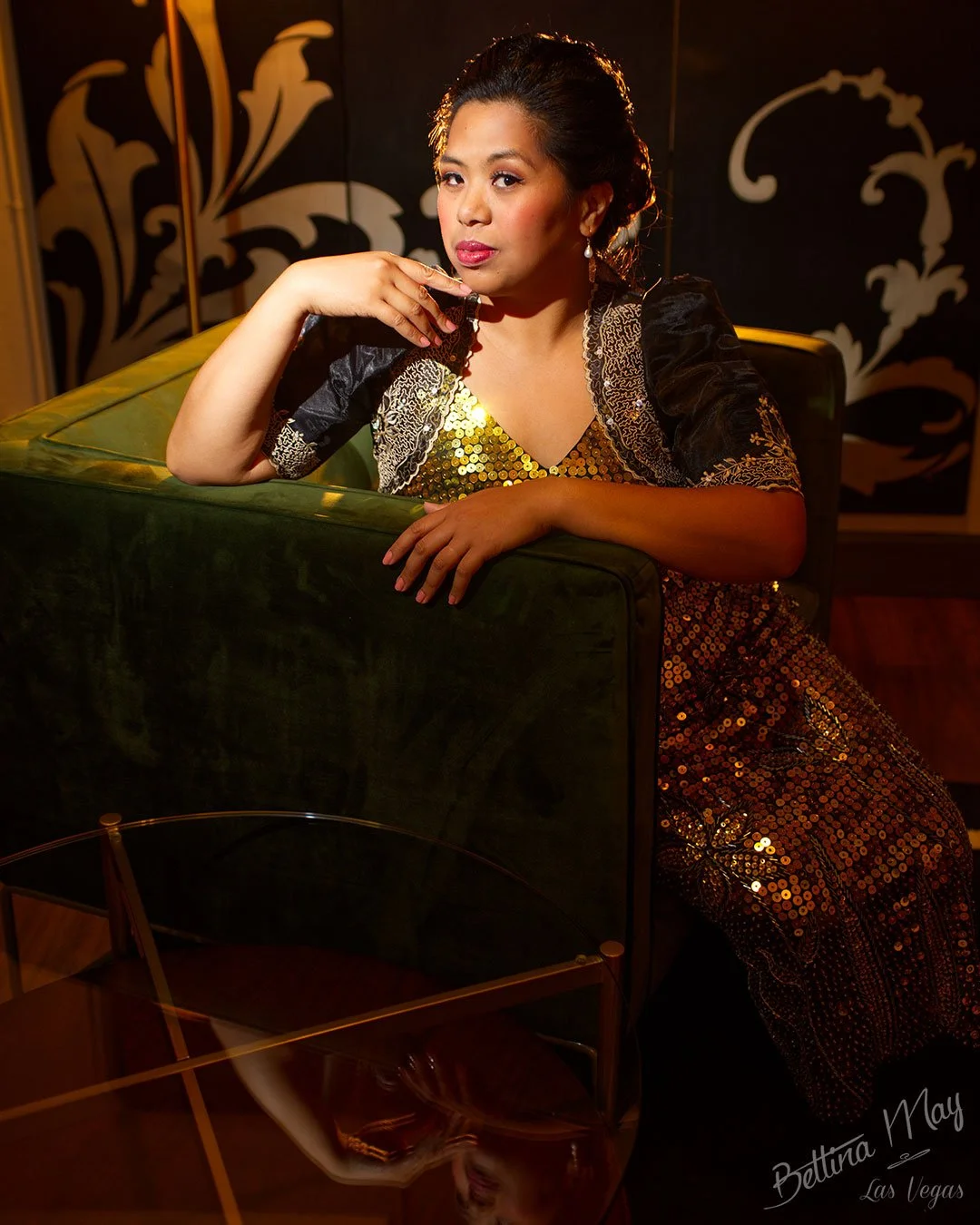
Pinay Grigio with a vintage sequined dress from her tita (auntie), featuring butterfly sleeves traditionally found on a terno
Photo by Bettina May Photography
I invite you to take a glimpse of what I carry onto the stage as a Filipino American burlesque performer.
P.S. You may also find yourself in the middle of a history lesson. Tara na! (Let’s go! - Tagalog, Filipino dialect)
Who is Pinay Grigio?
I am Pinay Grigio. The word pinay is slang for a Filipina woman. I added grigio to go along with the boozy theme that is common in many burlesque names. I didn’t want people to second guess who I was without seeing my face first. For those that are either Asian or aware of Filipino terminology, I wanted my name to be a statement and an identifier. Pinay Grigio! She’s definitely a Filipina. What a clever name! When I debuted at my Burlesque 101 student recital through the Academy of Burlesque in Seattle, WA, I had a different stage name. I wouldn’t say that it was a bad stage name, but it did seem like a very generic stage name. I changed it because I felt no connection to the name nor identified with the character development of this persona. I realized that my identity as a Filipina was important to me and I wanted to see more representation. After a month of brainstorming names, I found it and ran with it.
What is behind her tagline?
I am the Filipina Thirst Quencher— mesmerizing and tantalizing with a tropical smile. I was born and raised in Honolulu, Hawaii. My parents immigrated from the Philippines in the 1970s. I have lived in the Philippines for 4 years (high school years) and moved to Seattle after high school graduation. The Philippines is an archipelago in Southeast Asia composing of 7000+ islands (main island groups are Luzon, Visayas, Mindanao). It is known for its tropical climate and diverse regions. We have a mix of indigenous traditions and a culture shaped by colonization mainly through Spain (300 years) and control under the United States and Japan occupation. Within the Filipino population, you will find Filipinos of different descent (i.e. Spanish, Chinese, etc.). It is complex and beautiful. We are known for our hospitality and warmth. So if you think about what composes my tagline, it is the weight of all these factors. Pinot Grigio (although originating from Italy) is a summer wine. It is a white wine that is easy to drink during the hot summer months. Just like this beverage, I am refreshing and I hope to continue leaving my splash in the world of burlesque.
What is her style?
In both my presence as a performer and a producer, my main intention is to always lead with aloha. Yes, the concept of aloha is Hawaiian. And yes, from the surface it looks like I have no reason to incorporate a different culture’s belief system into mine. But remember, I was born and raised in Hawaii. There is a huge Filipino population in Hawaii. Our history goes back to the sakadas (Filipino labor workers) that worked in the sugar plantations and canneries, majority of these Filipinos coming from the Ilocos region. My family hails from Ilocos Norte where they speak Ilokano which is a Filipino dialect that is commonly heard in Hawaii. My grandmother worked in a cannery and my grandfather owned his own business as a landscaper. My roots in Hawaii are deep and I pay homage to this place by continuing to practice life with aloha. This entails kindness, respect, compassion, and a sense of connection to others. It is means treating others with warmth and caring for each other and the land. It shows up in our everyday actions like practicing gratitude, helping others, and acting with humility. It is my intention to share this spirit with you all, whether it is in my movement or how I connect with people on and off stage.
What does she stand for?
The cycle of self-doubt is wild. You hear that little voice that tells you that you are not allowed on that stage and find that this voice covers up deep wounds that stem from past experiences when we have been criticized, hurt, and conditioned to feel small. On a greater scale, you realize that this stems from centuries of pain, as deep as when the ancestors were harmed by colonization and had to adapt in order to survive. I carry baggage as a Filipino American and the biggest challenge I had to overcome as a Filipino American was allowing space for compassion to myself and to my body. My presence onstage is rebellion against the beauty standards of Filipinos. Filipino beauty has been attached to Euro-centric traits— Get out of the sun because you don’t want to get too dark! Straighten your hair, you want it silky smooth. Don’t eat past 6pm so you don’t gain weight! The comments are exhausting. The effects are detrimental. The amount of Filipino beauty products with bleach is disgusting. I was hating myself for my uniqueness. Burlesque has emphasized the importance of our own narratives and the ability to change them. I dance because I am brave, beautiful, and loved.
Burlesque has amplified the importance of self awareness pertaining to what I carry onto the stage. It is a reminder to carry this weight with kindness.
For those that are curious, this is how I manage to carry this weight with grace.
Rituals/little personal things that I do to remain grounded:
1. Recite a mantra before going onstage (mine is from the poem “Desiderata”).
2. Take a breath and reflect on the journey to stage— i.e. reflecting on the immigration story of my parents, the resiliency of my grandparents, etc.
3. When I put on make-up, I do not apply contouring powder to my nose. I love my Filipino nose— wide and warm. There is no reason to wish for it to look different.
4. After a performance/production, I take an extended bow by holding my hand to my heart and feeling it beat while I absorb the love from the audience.
5. I give myself space and engage in conversations and spaces where I feel safe. My energy is precious.
6. I acknowledge that my smile is sexy and it allows me to be my true self.
The journey to the stage is a mental, physical, and emotional one. But to have power and undo these patterns through burlesque is liberation. For my fellow AANHPI siblings, take care of yourselves. Our voices and our light belong on the burlesque stage.
